Friday, December 4, 2015

Spinning Tales About Honeybees


Honeybees are essential commercial crop pollinators.  They are worth billions to the global economy.


Hollow tree beehive - photo Brett Pigon

These insects develop an organized social colony accommodating a queen (elongated body), worker bees (multi-tasking females), and drones (males).  A beehive with an internal honeycomb provides nesting for some species; it is sometimes located in a rock crevice or hollow tree.  The honeycomb consists of hexagonal cells constructed from beeswax, from the stomachs of worker bees.  These cells contain the ongoing brood:  eggs, larvae, and pupae. During summer, possibly 80,000 bees complete the colony.  


Other shelters are exposed aerial nests.  Also, a beekeeper might provide an artificial hive—beekeeping is even depicted in stone-age cave paintings.   


From a larva selected by worker bees, the queen bee matures.  This larva is fed exclusively on royal jelly from worker bees—otherwise, the queen develops as a worker.  A virgin queen may fly more than once to a drone congregation area to mate for life with multiple drones from other colonies; drones have huge eyes to perceive her.  She stores millions of sperms.  During her lifetime, she may lay 1 million eggs; she controls the sex of offspring.  Obviously busy reproducing, the queen bee is maintained by worker bees.  Her scent (pheromone) regulates hive behavior. 

Honeybees ready to swarm - photo Brett Pigon


Woodpecker nest beehive - photo Brett Pigon
During winter, for warmth, worker bees cluster around the queen—drones are ejected.  Usually, in springtime, especially when overcrowding occurs, the current queen prime swarms with many bees to establish a new colony.  After swarms may follow.  The former colony sustains with a new queen.  Queens survive 2-8 years; worker bees and drones survive weeks or months. 


Honeybee on Florida native Rusty Lyonia - by Brett Pigon
Pollination occurs when worker bees seek nectar (later processed into honey) and pollen—nourishment stored in honeycomb cells.  Dance communicates food sources.  A single worker bee produces 1/12th of a teaspoon of honey per lifetime.  When foraging, bees intoxicated by ingesting fermented nectar or ripe fruit become aggressive, have flying accidents, or cannot find their hives—similar to humans.


How about stings?  Queens may sting especially rival queens without dying.  Worker bees sting and die.  Drones have no stingers but die after mating.  The sensationalized Africanized honeybees (killer bees) do not deliver a more potent sting, but they defend relentlessly in greater numbers.

Wild or kept, honeybees are in alarming decline:  colony collapse disorder.  Bees never return home—possibly disoriented.  Plausible causes are pesticides, breeders causing lack of genetic diversity, radiation from cell phones and communication towers, and genetically modified crops (less nutritious pollen).  Are honeybees canaries in the coal mine?
Undeniably, honeybees are indispensable.  For example, bone wax, made of beeswax, controls
bleeding during surgery.  90% of our cherries depend on honeybee pollination.  And honey, besides potential health benefits, is savory—ask any bear.

Sunday, November 8, 2015

Spinning Tales About Birds

Supposedly, birds evolved from theropod dinosaurs.  Worldwide, there are over 10,000 species. 

The largest bird is the ostrich; it is flightless.   Research suggests that after the demise of dinosaurs, a flying bird like the ostrich’s ancestor was able to forage on the ground.  Over time, it grew bigger and ultimately lost the ability to fly.  An ostrich egg weighs 3-5 pounds, the size of a cantaloupe, and takes two hours to hard boil!

The smallest species is the bee hummingbird.  Why the hum?  The wings beat fast (hum) as they hover like a helicopter.  Flying backwards is also possible.  Its egg is the size of a pea, and the nest is one inch in diameter.  An adult may reach 0.071 ounces.

Two categories classify newborns.  An altricial bird, such as a songbird or hummingbird, is born featherless or sparse, eyes closed, and helpless.  A precocial bird, such as a duck or shorebird, is born down covered, eyes open, and active.  The black-necked stilt, a shorebird, may leave its nest within one hour of birth; it readily combs the shallow water for food.  Yet, an altricial bird gains independence sooner.

When a nestling (completely dependent stage) matures, it leaves the nest and becomes a fledgling.  It may not fly well and often hops around, vulnerable to predators.  Identifying features are short flight feathers on wings and tail.  Generally, the parents guard nearby. 
Juvinile Cardinal - photo Brett Pigon

Distinguishing age relies on molt patterns and plumage.  The feathers of a young bird are less organized and stubby.  Sexual maturity varies.  A smaller bird matures earlier—the northern cardinal takes one year, and the bald eagle takes four to five years.

Communication abounds.  Even before birth, a chick inside an egg issues calls to parents.   A bird releases short and simple calls for flight and danger; an intricate song attracts a mate or declares territorial defense.  

Singing is learned early.  A nestling memorizes.  As a fledgling, it practices for months.  One song or more is memorized with varying versions.  The brown thrasher song types exceed 1,000.  

The mockingbird, Florida’s state bird, is a songbird that can mimic other birds, insects, frogs, cats, and even squeaky doors.  Its own varied and repetitive vocals may last all night in the springtime.

Trivia…Eat like a bird is misleading—a bird may eat twice its weight daily.  Feeding waterfowl white bread crumbs causes malnutrition—nourishing food is shunned.   A bird’s heart beats up to 1000 times per minute when flying.  A bird does not sweat. 

Indeed, birds are essential!  They eat insects, pollinate, and disperse seeds.  Moreover, especially during the breeding season, breathtaking colors are displayed.  Such treasures!

Friday, October 2, 2015

Spinning Tales About Bats

Bats, those creatures of the night!  Relentlessly, literature, movies, and cultures stigmatize these weird-looking, mostly nocturnal mammals.  For example, Dracula transforms into a bat.  Some Native Americans label them trickster spirits.  Nevertheless, in China, they symbolize happiness.
Meet the real bats!   After rodents, they are the second largest order of mammals.  Species number around 1,000; Florida claims 13 native species.   Reproduction cycles are controlled by the female to coincide with food availability.  Mostly, a female yields one pup yearly.  Adult size varies from that of a bumblebee to a Canadian goose, wing to wing.  Lifespan exceeds 30 years.  Except for colder regions like the Arctic, bats dwell worldwide.
Some bats are solitary.  However, thousands colonize and hang upside down by clawed toes from cave ceilings and walls to roost (rest) during the day, safe from predators.  (Bracken Cave in Texas—an estimated 20 million.)  Spectacular are evening mass exits!  Caves are also utilized for hibernation.  With habitats disappearing, some bats are roosting in abandoned mines. 


Bat drawing by Hailey Scalia, age 8
The only mammals capable of true flight are bats.  Some fly 40 miles per hour and cover 50 miles nightly.  Dives are spectacular!  Many migrate from Canada to Mexico.  Bat wings are thinner than bird wings—better maneuverability.  These membranous wings have arms, long fingers, and little thumbs.  Regrowth of membrane repairs tears.
Most bats are insectivores.  One bat may consume hundreds of insects in one hour.  Others may ingest pollen, nectar, fish, blood, and even other bats.   Younglings nurse on milk.  Sharp teeth facilitate insect and fruit penetration.  Tube-lipped nectar bats display the longest tongues of mammals, relative to size.  After deep-flower probing, such a tongue coils up inside the rib cage. 
Vampire bats are native to Latin America.  The common species lick (do not suck) blood from sleeping mammals like cattle and occasionally humans.  Only a tablespoon is drawn.  Bat saliva contains Draculin, the anticoagulant named after Dracula, to keep the victim’s blood from clotting.  Fortunately, less than 1% of bats carry rabies. 
The ultrasonic shrieks of nocturnal bats (typically not audible to humans) echo off objects.  Unique ears and noses assist in echo interpretation to locate prey and navigate—echolocation, natural radar.
Blind as a bat?  Bats dart at night, seemingly blind.  However, they can see, night or day.  Vision varies from poor to excellent.  And bats do not entangle in hair—they dive towards insects surrounding people’s heads. 
Let us go to bat for bats!  They control insects.  They pollinate.  Guano (feces) is a great fertilizer—also used for gunpowder during the Civil War.  Furthermore, bats are vital for hibernation, sonar, and blood-clotting research.  Beneficial creatures!

Sunday, September 6, 2015

Spinning Tales About Albinism in Nature

Albinism appears in approximately three hundred animal species in North America.  This is a rare inherited absence of pigmentation or coloration.  It is speculated that factors other than genetic ones, such as age or diet, may cause this abnormality.  Plus, fish eggs exposed to heavy metals, like copper or mercury, can produce albinos.


Albino rat photo by Hailey Scalia, age 8
Initially, verification of albinism relies on pigmentation and coloration.  For instance, the majority of mammals have just the melanin pigment, but many animals have pigments other than melanin.  Some, like certain butterflies, have pigments and structural colors.  Such diversity hinders interpretation! 


Generally, defining traits are white hair or fur, skin, feathers, scales, and cuticle.  Yet, not all albinos are pure white!  Eyes are commonly red or pink resulting from the lack of pigment in the iris which exposes the blood vessels of the retina.  However, blue or green eyes do surface. 


Misleading are animals mistaken for albinos, such as those with leucism, a partial loss of pigmentation.  This happens to many creatures—like tigers, hawks, fish!  They emerge white, pale, or patchy but usually have normal eyes.  How about flamingos which appear white if they have insufficient red carotenoid pigments in their food? 


In reptiles, birds, and amphibians, albinism is more prevalent.  Large snakes like diamondbacks and boas tend to be affected—often pinkish and yellowish. The occurrence is 1 in 1800 birds, often house swallows and American robins.  In mammals, it is 1 in 10,000.  


Unique are albino bottlenose dolphins.  Only 15 were reported since 1962.  In 2007, a pink one appeared in a Louisiana lake—pink because blood vessels were exposed through blubber and unpigmented skin.  The last sighting of an apparent true albino was in December, 2014, in the Indian River, right here in Brevard County!


The pet industry thrives on breeding albinos, especially Norway rats (also named brown rats); moreover, they are esteemed laboratory rats.  Other favorites are albino Burmese pythons, patterned white with yellow and orange.  Often bred, but scarce, are blue-eyed leucistic Burmese pythons; though non-albinos, they are equally stunning with their white bodies void of markings.  In 2013, a 13-foot albino Burmese python was captured in Hialeah, Florida.  An escaped pet?  


Captivity increases survival for albinos.  In the wilds, life is challenged by such obstacles as exclusion from family, lack of camouflage, impaired hearing and vision, and sun sensitivity.  Alligators might survive only 24 hours.  Perplexing are albino squirrels which seemingly survive as well as pigmented species! 


Tame or wild, albinos intrigue!  On a nature walk, a little scrutiny might reveal an albino land snail gliding by.

Friday, July 31, 2015

Spinning Tales about Butterflies

White peacock  - photo Brett Pigon
Butterflies are insects with fluttering wings, exquisitely painted by nature.  They are closely related to moths, but differences exist.  Butterfly antennae are commonly clubbed, and moth antennae are not; butterflies are smooth and slender, and moths are mainly stout and hairy; butterflies usually rest with folded wings, and moths usually spread them out.


Cycles of butterfly are  egg, caterpillar (larva), pupa (chrysalis), adult.  Usually eggs are laid on the underside of leaves on caterpillar host specific plants (monarchs prefer milkweed).  Before laying, butterflies taste these leaves to insure safety for forthcoming devouring caterpillars. They taste with their feet—their sense of taste is 200 times stronger than humans.  Eggs are fixed to leaves with special hardening glue.  Depending on region, more than one brood may occur yearly.  Among species, survival lasts one week to nearly a year. 
Queen  - photo Brett Pigon
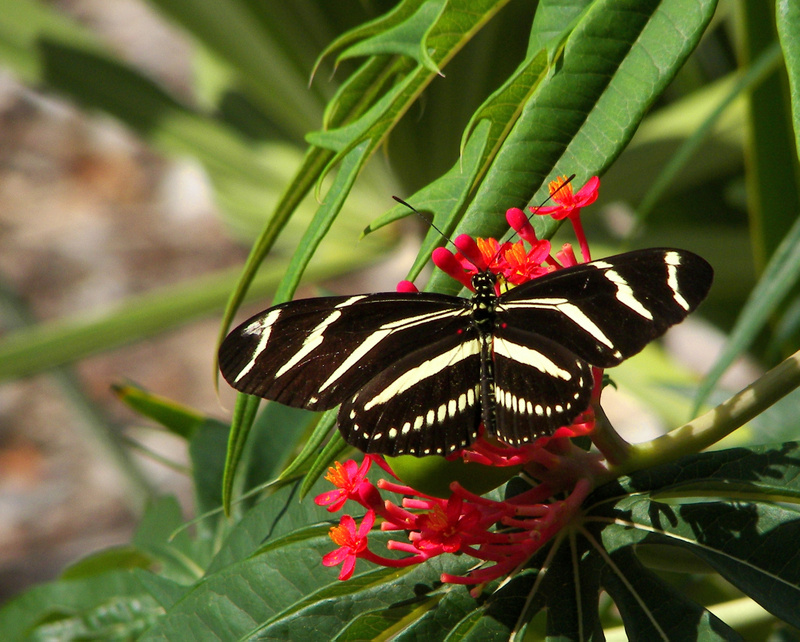
Coloration is determined by overlapping of thousands of minute wing scales.  Certain butterflies display bright colors to proclaim foul taste and toxicity, transmitted by their caterpillars consuming toxic host plants.  For example, the brilliant orange migratory monarch and the vivid black and white striped zebra longwing, Florida’s state butterfly, deter predators.  For camouflage, some butterflies resemble leaves.  (Butterfly structural coloration—result of scattering of light by scales—inspires research in non-toxic paint!)
Zebra Longwing - photo Brett Pigon
Nectar is flight fuel for butterflies.  Because these insects see ultraviolet light, ultraviolet patterns on flowers guide them to nectar sources; antennae also detect nectar.   Preferable is nectar with amino acids; they stimulate more egg laying.  Often sought are blooms with deeply-hidden nectar—drawn with a long tongue (proboscis) that uncoils and simulates a straw.   Cluster flowers provide landing platforms.  Favorite colors are bright red, yellow, and orange like red penta, goldenrod, and butterfly weed.  Though not as efficient as bees, butterflies pollinate special plants, transfer pollen long distances, and contact many flowers. 
Two forewings and two hind wings enable flight.  Double antennae provide flight balance and orientation—with only one antenna, flight might be circular.  Well-equipped, butterflies hover and fly backwards and sideways at low speeds.  These seemingly erratic behaviors are in complete control!   Aeronautics engineers aspire to imitate butterflies, such as developing robotic spy insects.
Black Swallowtail - photo Brett Pigon
Approximately 700 species of butterflies inhabit the United States.  Butterflies are invaluable indicators of fluctuations in ecosystems.  For instance, change of habit signals climate variation, and discoloration might imply poor air quality.  Preserve butterflies; plant flowers!

Haiku by Hailey Scalia, 8, local conservationist: 
Butterflies flying
Symmetrical wings flutter
Beautiful insects
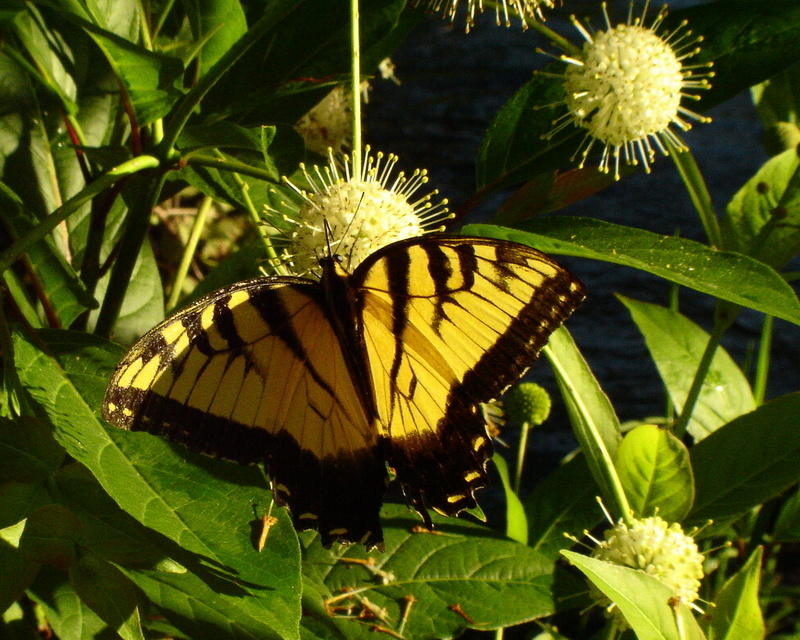
Eastern Tiger Swallowtail - Brett Pigon


Monarch - photo Brett Pigon


Friday, May 29, 2015

Spinning Tails About the Viera Wetlands

There is a wildlife haven in Brevard County—Ritch Grissom Memorial Wetlands (named after a deceased county employee), more commonly known as Viera Wetlands. This man-made habitat is as outstanding as any of Florida’s natural wetlands.
Viera Wetlands - photo Charlie Corbeil
Morning Fog - photo Charlie Corbeil
White Heron - photo Charlie Corbeil


Viera Wetlands - photo Charlie Corbeil
Mottled Ducks - photo Charlie Corbeil
Initially, visionaries planned polishing ponds to help with water purification and also create wetlands. Hopefully, wildlife would be attracted, especially waterfowl. Moreover, the nutrient-enhanced effluent from the primary treatment process would support the food chain. 
Today, the synergy of water treatment and wetlands transcends expectations. Flora and fauna thrive! In this sanctuary, simple dirt roads and grassy berms allow photographers, bird watchers, and local or foreign enthusiasts to enjoy a leisurely drive, walk, or restful stop among soothing surroundings. And one might just linger and chat! 

Vegetation characteristic of natural environments—trees, grasses, rushes, aquatic plants—provides nourishment and cover for various creatures. Deer and alligators are common. A discreet photographer may capture an otter frolicking with her pups in the water. On summer evenings, one may sight a partially-submerged pig frog as it bellows pig-like grunts. How about the bobcat that climbed the observation deck? 

Successful reproduction occurs in this refuge. I observed great blue herons utilize a cabbage palm for nesting. The female accepted sticks and twigs from the male and built the nest. Several days later, she lay three pale-blue eggs. Incubation was shared by both, and two nestlings emerged in 28 days. The unhatched egg disappeared the next day. The pair fed regurgitated fish and vegetation directly into their chicks’ bills. The younglings fledged in two months. 

Stunning insects abound! The exquisite zebra longwing, the designated state butterfly, is identifiable by its striking black wings with yellow stripes. It frequents the passion flower vine, a larval host plant. The spotted cucumber beetle, with its vibrant coat of yellowish green accentuated with six black dots on each wing, also embellishes the local foliage. 

Obviously, the wetlands is for all to conserve and enjoy. Recently, at the annual Viera Wetlands Nature Festival, Hailey Scalia, a second grade student at the Ralph M. Williams, Jr. Elementary School, received the top prize in both writing (poetry) and art at the Charlie Corbeil Conservation Awards. Her brothers Joseph and Evan were there to applaud her. “Conservation is good because you can see the beautiful nature,” claimed Hailey. Indeed, the future of nature is in caring hands!
Hailey Scalia - double winner at the Charlie Corbeil Conservation Awards, in writing and art

Sunday, May 24, 2015

Spinning Tales About Pollinators

Honeybee on Rusty Lyonia - photo by Brett Pigon
Plants are vital to humans and many living things.  Through pollination and resulting fertilization, plants produce necessities, such as  food for nourishment, cotton for clothing, lumber for shelter, and seeds for reproduction.   


Pollination is the transfer of pollen in a flower from the anther (male) to the stigma (female).  It  may be intentional, incidental, or accidental.  Methods of pollination:  cross pollination (used by most plants)—the transfer of pollen from one flower to the stigma of another in a different plant of the same species by an insect, animal, wind, or water; self pollination—the transfer of pollen to the stigma within the same flower through shedding; artificial pollination—hand pollination by a human.


Carpenter bee on Buttonbush - photo by Brett Pigon
Honeybee on Rusty Lyonia - photo by Brett Pigon
Performance varies in pollinators.  Butterflies do not always efficiently pick up pollen with their bodies, legs, or tongues, although they are helpful with pollinating certain plants.  However, hummingbirds, with their long tubular bills, skillfully retrieve pollen from deep-throated flowers.  Actually, the exceptional pollinators are bees.  They intentionally collect nectar for energy and pollen for protein, and nature helps them gather this pollen with fuzzy bodies, special hind legs and abdomens, and electrostatic charge.  Furthermore, some bees, especially bumblebees, buzz pollinate—move flight muscles rapidly, causing vibration in the anthers to better release pollen in self-pollinating plants like tomatoes.  Because a large portion of food consumed is dependent on bees, they are worth billions to the global economy.   Supposedly, Albert Einstein estimated that humans would only exist four years if bees disappeared; therefore, the noticeable population decrease in these insects is alarming.  Habitat loss and degradation threaten wild species.  Consequently, growers rent or purchase bees (commercial crops are primarily pollinated by honey bees), but managed bees suffer from parasites, pathogens, and pesticides.  In some regions of China, where pesticides have discouraged bumblebees in apple and pear crops, artificial pollination is necessary.


Honeybee on Rusty Lyonia - photo by Brett Pigon
Most essential is the pollination of trees.  Besides providing food and shelter, trees are the lungs of the earth—they release oxygen.  They also furnish fuel—sunken, compressed trees ultimately become coal which fuels electricity.  How about pines (conifers) which produce turpentine through the distillation of their resin? 


Obviously, pollination is crucial.  The sudden urge to swat annoying bees or destroy any pollinators should be repressed—these beings may determine whether there are delicious apples to savor or colorful flowers to smell.  And these flowers will in turn attract needed pollinators!


Carpenter bee on holly tree - photo Brett Pigon

Carpenter bee on Buttonbush - photo by Brett Pigon

Honeybee on cactus flower - photo by Brett Pigon